
-Aanya Jaidka
One of Jack Penn’s famous quotes is “One of the secrets of life is to make stepping stones out of stumbling blocks,” which India’s space endeavour perfectly encapsulates. It’s a tale about having lofty goals, taking chances, and the tenacious efforts of numerous ISRO scientists.
On 7th September 2019, around 1:40 a.m., ISRO officials and scientists gathered in the control room to view Chandrayaan-2’s Vikram Lander land on the moon. 1.3 billion hearts broke while a room full of ISRO scientists watched Chandrayaan-2’s Vikram Lander end up spinning over 410 degrees, deviating from a calibrated spin of 55 degrees, making a hard landing on the moon. As someone rightly said, “Failure is a stepping stone to success,” ISRO scientists geared up, determined to come back stronger than ever with a follow-up mission that would successfully be able to demonstrate softlanding on the lunar surface.
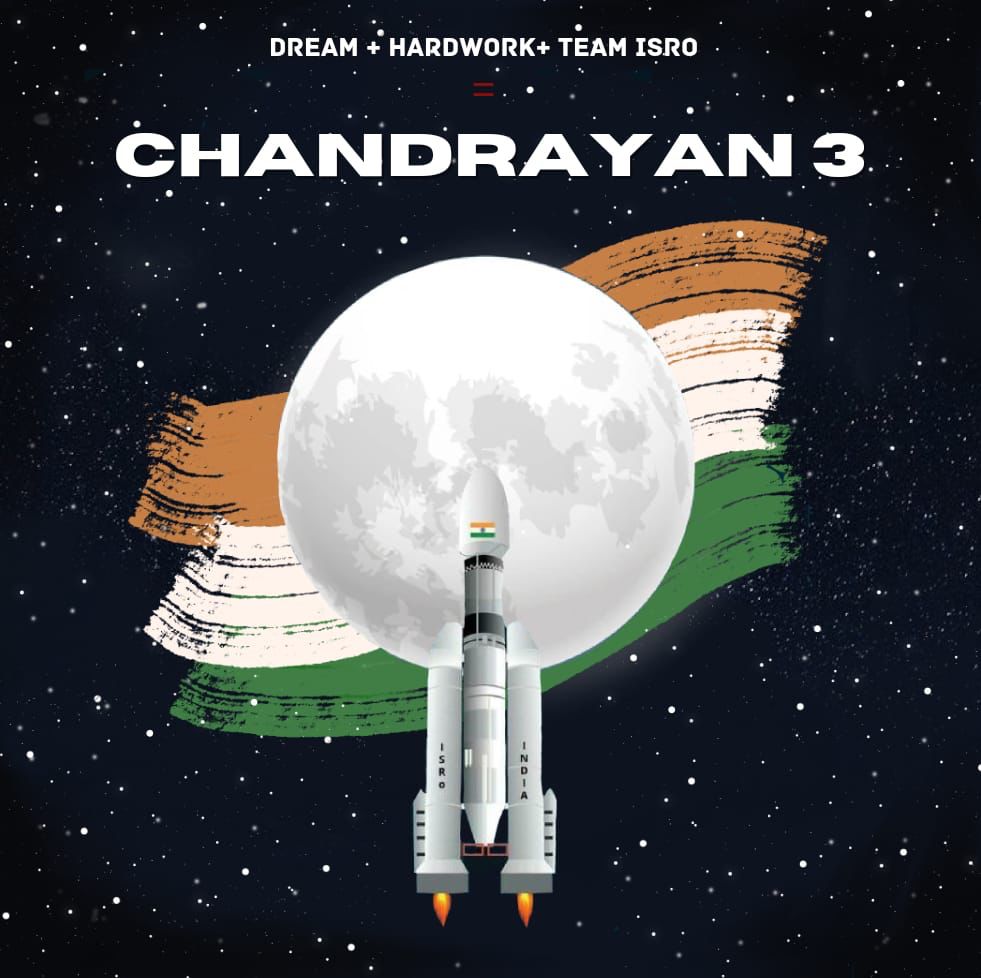
Almost 4 years later, ISRO scientists assembled in the control room once again, this time, alongside the entire country to witness history being made as Chandrayaan-3’s Vikram Lander successfully softlanded near the Moon’s South Pole, making India the fourth country to land on the moon. The objective of Chandrayaan-3 is to demonstrate the Rover roving on the moon and to conduct in-situ scientific experiments. What makes the Chandrayaan-3 mission different from other space programmes is that this mission also focuses on checking the availability of Hydrogen and Oxygen on the surface of the moon. A week after the successful landing, Chandrayaan-3 has already confirmed the presence of Sulphur, Aluminium, Oxygen and Iron among other elements on the lunar surface. Chandrayaan-3 being the first to land on the south pole of the Moon has also profiled the lunar topsoil present there and its temperature variation.
Another remarkable thing is how the ISRO team managed to achieve this incredible feat in such a short period of time despite being on a very restrictive budget. The Chandrayaan-3 Mission cost only about $72 million whereas most blockbuster space movies cost more than $100 million. Chandrayaan-3 took India to the moon at less than half the cost of Interstellar, which was filmed on a budget of $165 million. ISRO scientists have revealed that they were able to accomplish this on a tight budget by cutting down on the number of qualifying tests and ensuring that each test is done with a lot of risk analysis and simulation and making most of the rocket’s parts in India itself. The team has attributed the success of their cost efficiency plan to three factors – indigenisation, ingenuity and affordable manpower.
Announcing that Chandrayaan-3 had completed its primary tasks and had been “set into sleep mode” on September 2nd, S Somanath, the head of the Indian Space Research Organisation (ISRO), believes that the Chandrayaan-3 mission is primarily a success because it has already achieved its declared objectives despite numerous unsuccessful attempts to awaken the Vikram-Pragyan pair.
In general, it has been a historic occasion that allows India direct access to another planetary body. The fact that we are one of the few nations with this capability puts us at the cutting edge of this technology and allows India to have a bigger voice in determining policies on space exploration. The fairy tale continues with the Aditya-L1 mission!
 The Echo