
-Ayaan Unni
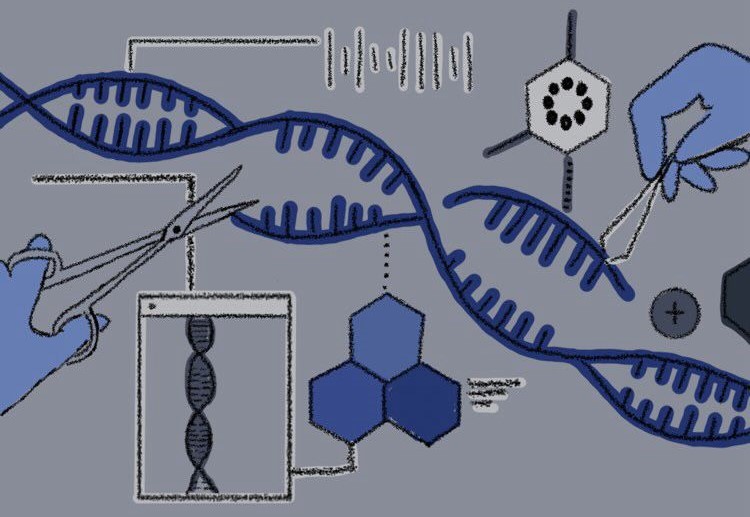
What would, say, a caveman think if they were to suddenly enter the 21st century? What would the King of the Cretaceous Period – The Tyrannosaurus rex – think of a nuclear explosion? While these answers are most likely never to be reached, us modern humans might have just been pushed into a situation where we are the T.rex or we are the cavemen with this situation being an attribute of the rise of CRISPR (Clustered Regularly Interspaced Short Palindromic Repeats).
A Short Understanding of Genome Editing
Humans have, since their establishment wished to control all that’s around them, indulging at a very miniscule degree in the act of genetic engineering which is in simple terms, “To change something on an elementary level,” which in the case of genetic engineering is the editing, deleting, copying, pasting and messing up of DNA (Deoxyribonucleic Acid) and RNA (Ribonucleic Acid).
What is CRISPR?
CRISPR, a captivating tale, unfolds in the pages of microbiology. Imagine this: bacteria, striving to survive, faced daily annihilation by bacteriophages, relentless ocean predators claiming 40-50% of their kin each day. To counter the viral onslaught, bacteria seemed to undergo genetic evolution. They devised their antidote, akin to a cutting-edge AI swiftly diagnosing ailments. CRISPR, the bacteria’s answer, identifies the intruding genetic strand, much like editing words in a document. Scientists deciphered this ingenious defense, gifting us a potent tool to rewrite the code of life.
CRISPR’s Medical Potential
A unique study conducted in 2016 had scientists conducting a large scale CRISPR application on rats with a composition of entirely HIV infected cells. They were-simply by injecting CRISPR into the rat’s tail – able to remove up to 40% of the virus from the rats body showing how higher precision applications could perhaps have removed it entirely. What does this entail? A more positive outlook would be that this could signify the potential end of diseases. If HIV can be cured, then why not move onto deadlier and more large-scale issues like one of humanity’s worst enemies, cancer, to the point that it’s no more than a common cold to the humanity of the future.
The Modification of Human Beings
Now, let’s observe a Catch 22 situation in the future, a future where ads promise perfect babies, a life free from diseases, and effortless strength. We’ve glimpsed such claims today, even without CRISPR, often finding them to be scams. Sadly, the world has its share of gullible souls and those who exploit them. Now, picture a world where these changes are real. Some might envision a disease-free, longer life, but it’s a privilege to even contemplate this. In a land where millions struggle to survive on less than ₹32 a day, will such benefits reach them? Regrettably, no. We’d likely witness more exploitation. Yet, unstoppable is an idea whose time has come. Human modification, still in its infancy since Chinese scientists ventured into it in 2016, could soon shape our lives, for better or worse. Will this tale be titled “From Beauty to Blunders” or something brighter? That’s a story we not only cannot witness but also shape, each in our own small way.
Challenges with Respect to CRISPR
While the technology is new and still experimental, the challenges related to it are really quite basic. Let’s divide that into technology related and human related. Tech challenges are usually over a period of time. Computers known as ENIAC were first invented in the late 40s costing approximately $400k and it took almost 30 years after that for the desktop to reach the average household. So in essence, technology evolves. This too shall evolve and at its precipice become a force to reckon with. It will most likely end up changing humanity for good, although it might take generations to happen. Now, what does not evolve is human greed, vanity and lack of empathy in the name of science. These are something which have been prevalent since time immemorial and will exist for millenia to come. To curb this, we need stronger laws and governance and a sense of responsibility.
What must we infer from this Colossus of Genetic Engineering?
If our Genome was a symphony, then CRISPR is its most valuable note, having the potential to, if well played, harmonize our future while also risking the ruining of the performance if misused or misinterpreted. Let’s make sure we are not encountered with a situation where succeeding generations point out, us being bystanders to something with infinite potential being shoved into ground.
 The Echo