
-Mahi Jamuar
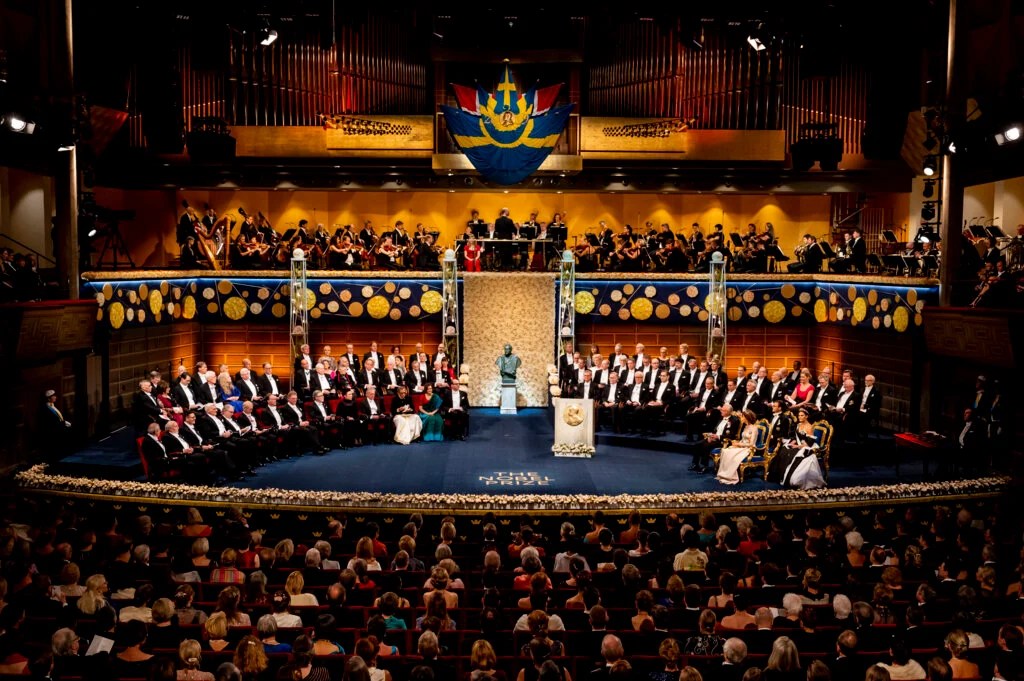
On the 10th of December of each year, we observe one of the most prestigious ceremonies in the academic world. A historical event, to honour historical events. For over one hundred and twenty years, the Nobel Prize has been awarded on the death anniversary of Alfred Nobel. The Nobel Prizes were created by Alfred Nobel, a chemist and industrialist from the 1800s, who stated in his will that all of his assets be compiled into a fund, the interest on which would be distributed annually as prizes to ‘those who, in the preceding year, have conferred the greatest benefit to humankind.’
True to these words, the individuals and organisations on the receiving end of this laurel have presented humanity with extraordinary gifts of knowledge. From Marie Curie to Einstein and Mother Teresa. From Martin Luther King Jr. to Heisenberg and Rudyard Kipling. Their contributions to their fields have advanced technology and society by leaps and bounds over the past century.
The first prize to be announced this year was in physiology and medicine. Awarded to Katalin Karikó and Drew Weissman for their work concerning nucleoside base modifications, which helped in the creation of mRNA vaccines. It should be known that these mRNA vaccines are the very ones that helped the world beat COVID-19. Traditional vaccines inject our bodies with a weakened virus, which triggers the creation of antibodies. mRNA vaccines also prompt the immune system, but instead of introducing a virus, the mRNA instructs the body to make the pathogen itself.
The Nobel Prize in Physics was awarded to Pierre Agostini, Ferenc Krausz and Anne L’Huillier. They created pulses of light so fast and quick that they could record and study the movement of electrons inside an atom. These pulses of light are measured in attoseconds, which is one quintillionth of a second. To put things into perspective, an attosecond is to a second what a second is to 31.7 billion years. The predicted age of the universe is 13.7 billion years. Sit on that for a while.
The prize in chemistry went to Moungi G. Bawendi, Louis E. Brus and Alexei I. Ekimov, for the discovery and synthesis of quantum dots. An extremely small particle was measured on the nanoscale, at such a small size, these particles began acting differently. The size of the dots affects the colour of the particle; the larger particles shine yellow and red, while the smallest ones shine blue. The properties of these human-made particles are governed by quantum mechanics, which sounds like something straight out of a marvel movie. On the contrary, these particles are used in some of the most mundane aspects of life, from LED screens to imaging in biochemistry.
The Nobel Prize in literature was received by Jon Fosse for his innovative plays and prose, which give voices to the unsayable: A Norwegian writer well known for his plays and his novels. His work, the Septology, is considered his magnum opus. While it has three volumes and a multitude of parts, this, sometimes existential, novel is written as one long sentence. Fosse’s influence is truly extreme; one of his plays has opened somewhere every thirteen days for thirty-five years.
The Nobel Peace Prize of 2023 was awarded to Narges Mohammadi. Currently a prisoner in Iran, she is a women’s rights and human rights activist. A leader in the women-life-freedom movement in Iran, one of the largest since the establishment of the regime in 1979. Her children accepted the laurel on her behalf and Mohammadi started a new hunger strike in prison after receiving her award.
The Sveriges Riksbank Prize in Economic Sciences was presented to Claudia Goldin for her research in advancing the understanding of women’s labour market outcomes. She studies the wage gap between women and men, all the way from the late 18th century to the present. Her work shows the lack of economic growth for women and the spike in the 1960s, which can be attributed to the introduction of family planning and birth control pills. She shows the interconnectedness of their status as mothers and their work life, as well as the increased wage gap because of it.
Through their intelligence, sentiment and courage, these people have furthered and bettered society and mankind. Whether it be in the sciences or liberal arts or their humanitarian work, they have worked towards the community, bringing change and a promising future. And their discoveries will truly make the world a better place.
 The Echo