
-MS Meenakshi
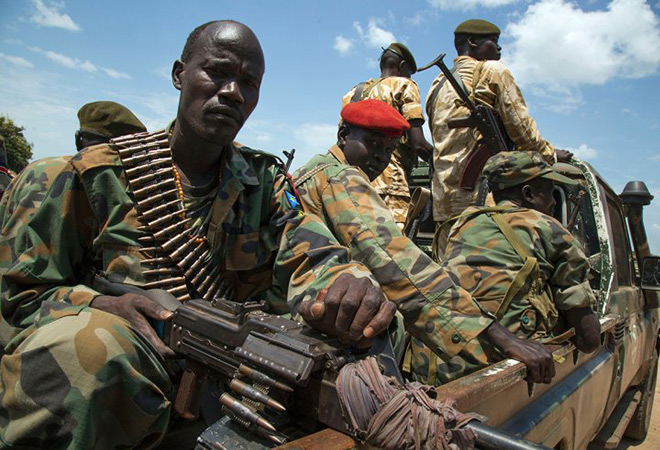
The entire global community has been pushed into turmoil by the news of the ongoing conflict between Israel and Palestine. However, it is important to remember that the message of peace, “Free Palestine,” is also equivalent to the plea to free other nations bound by the cruel curse of conflict. We must be aware of all views and not just one. An apt example of the same is the Sudanese Civil Conflict.
The Past
The unsettling conflict roots in Sudan can be traced back to its terms of colonisation by Britain and Egypt. Even after its independence in 1956, the newly formed government had hardly any experience in dealing with the country’s diverse population and their conflicts. The Sudanese political parties were not well-organised groups with distinct objectives but loose alliances motivated primarily by personal interests and loyalty to various religious factions. Extreme frustration and unsuccessful attempts to sustain a nation that was oppressed for such a long time eventually led to a bloodless coup and the establishment of the Supreme Council of the Armed Forces. Because of this, several changes came in place, primarily, demonstrating the importance of dominance of the north Sudanese, who were Arab Muslims over the African Christians and other groups in the south and west.
In short, as seen in history multiple times in the past, this change emphasised the dominance of the north Sudanese, who were Arab Muslims, over the African Christians and other groups in the south and west. This majority dominance resulted in rebellion and repression, eventually leading to the military regime’s loss of control. A transitional government was appointed in response, but democratic failures led to a 1969 coup by Col. Nimeiri, reinstating a military regime. Despite an attempted coup by rebels, ongoing power struggles failed to resolve the constant ethnic and religious conflicts.
However, this constant game of tug-of-war for power still did not solve the problem of constant ethnic and religious conflict in the state. Because of the south was dissatisfied with Nimeri’s rule, the Sudanese People’s Liberation Army (SPLA) and Sudan People’s Liberation Movement (SPLM) came into place. And from 1983 onwards there was a time of constant war and conflict in Sudan between the SPLA, SPLM, and the military government that supported political parties.
After several bad decisions, protests, economic and political struggles, numerous cease-fires, agreements, and peace discussions, the civil war finally ended when the Government of Sudan signed the Comprehensive Peace Agreement (CPA). However, once South Sudan was able to gain independence in 2011, it led to a series of disagreements between Sudan and the newly formed South Sudan once more.
Alex DeWall from Tufts University, who is an expert on the matter, was called to the country in 2005 as part of an African Union effort to negotiate an end to fighting in Sudan’s western region of Darfur. He later stated, “Quite a few times I’ve been meeting with Sudanese generals, and they have this mindset when they go to war, which is, ‘We will land a knockout, killer blow on the other guy. We can win a decisive victory, and don’t stop us.’ And they’re always wrong. Invariably, they cannot achieve that decisive victory.”
The Present
Following further discontent that overthrew the regime of the former president, Omar Al Bashir ,who was later surrendered to the International Criminal Court in February 2019, talks resumed between civilian groups and military leaders regarding a transitional government, but, sadly, they collapsed due to continued disagreements. Demonstrations and protests did not cease, and the military’s response was brutal – a massacre leading to the deaths of approximately over 100 people. This incident led to the suspension of Sudan’s membership in the African Union.
Soon after this, in 2021, another coup took place, with a promise to hold elections in 2023. However, protests still continued in different parts of the country. Meanwhile, the military coup was widely condemned on the international stage and jeopardised plans for much-needed aid and debt relief for the country.
When April 2023 rolled around, the situation worsened with clashes between the Sudanese Armed Forces (SAF) and a paramilitary group, the Rapid Support Forces (RSF), which had steadily turned into a civil war. Caught in the crossfire are Sudanese civilians, who are experiencing a growing humanitarian crisis.
The main victims of this civil war seem to be the civilians living in Darfur, a region in West Sudan. The RSF has been involved in acts of violence that have taken the lives of hundreds of civilians in early November 2023, now with a rapacity that far exceeds the executions of the Janjaweed, another militia and the RSF’s predecessor. Witnesses and victims claim that the Rapid Support Forces and allied forces shot at civilians as they fled and executed people in their homes, shelters, and in the streets, particularly targeting members of certain ethnic groups. This civil war is pushing the country to the brink of a humanitarian catastrophe. As an allegedly genocidal RSF gains the upper hand, a U.N. official has warned that Sudan is “facing a convergence of a worsening humanitarian calamity and a catastrophic human rights crisis.”
 The Echo